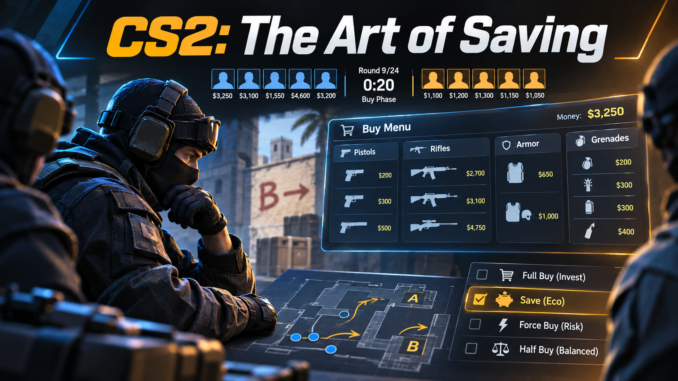
The round is over, your team is broke, and someone has already bought a Desert Eagle. Another player wants to save. A third says, “Just force it.” Sound familiar?
In Counter-Strike 2 (CS2), a match can start going wrong before anyone fires a bullet , right there in the buy menu.
Aim wins duels. Economy gives your team a fighting chance to win the rounds that follow. And sometimes the smartest purchase is no purchase at all.
“Man, I go way back to the OG Counter-Strike days. I can still feel the back pain from lugging that heavy Pentium 1000 rig and a massive, bulky CRT monitor to a friend’s house for a proper LAN party. Wires tangled everywhere, mountains of junk food, and a legendary 3dfx Voodoo 5 5500 pushing those glorious FPS. Once we finally hooked up the network, it was time to rush de_dust, outsmart the annoying campers on cs_assault, and pwn some noobs on cs_italy. Ready to rack up those frags… and let the battle begin!”
Today, Counter-Strike 2 is a global esport, with professional teams and tournaments around the world. The scale has changed enormously, but one thing hasn’t: the team that makes the smarter decisions often has the edge.
The Money Game Behind Every Gunfight
CS2 rewards players for rounds and certain actions, then asks them to spend that money on weapons and equipment.
A strong buy might include rifles, armour and useful grenades. A weak buy leaves gaps in the plan.
The real question isn’t simply, “What can I afford now?” It’s “What will this leave us with next round?”
Understanding the economy means knowing when to spend, when to save and, most importantly, when to coordinate your resources with the rest of your team.
CS2 Economy Explained: Eco, Force Buy, Half Buy and Full Buy
Every Counter-Strike player should understand four fundamental purchasing strategies.
| Strategy | What it means | Main objective |
|---|---|---|
| Eco Round | Spend very little or nothing. | Save money for a stronger future round. |
| Force Buy | Spend available money despite limited resources. | Contest a round when the potential reward justifies the risk. |
| Half Buy | Purchase limited equipment while keeping some money. | Balance immediate competitiveness with future buying power. |
| Full Buy | Equip the team with rifles, armour and appropriate utility. | Enter the round with a coordinated and well-equipped lineup. |
These aren’t rigid rules. The best choice depends on your team’s finances, the match situation and the opponents you’re facing.
The Trap: Five Players, Five Different Plans
An eco is a deliberate decision to spend very little and rebuild. A force buy is the opposite: you invest what you have because contesting the current round is worth the risk.
A half buy sits in the middle, preserving enough money for a stronger later round. And a full buy means fielding the equipment needed to execute your plan.
None of these choices is automatically right.
The mistake is making them in isolation.
One player with a rifle and four teammates unable to support it can turn a clever individual buy into a poor team decision.
Sometimes a teammate buying a weapon for someone else is part of a sensible plan; the key is that everyone understands the trade-off.
The rule worth remembering: You are not buying five separate loadouts. You are buying one round together.
Three Questions to Ask Before You Click BUY
Before spending your hard-earned in-game cash, consider three fundamental questions.
1. What can we field together?
Count the weapons, armour and utility already available, including gear carried over from the previous round. A coordinated team with modest equipment can be more effective than five players making disconnected purchases.
2. What happens if we lose?
Look at the money available next round. A desperate force buy may create another weak round, putting your team at an even greater economic disadvantage.
3. What are we playing against?
Consider the opponent’s likely equipment and whether your current buy supports a real tactical plan. Understanding the enemy’s economy is almost as important as managing your own.
Your Call: Buy Now or Build for Later?
Imagine this situation.
Your team has just lost a round. You can afford one decent rifle, but most teammates cannot. There’s enough time left in the half to rebuild.
What would you do?
- A) Buy the rifle — your aim will carry the team.
- B) Ask the team to compare a coordinated low-spend round with a credible force buy.
- C) Buy whatever is left in the menu.
The best answer is B.
The correct decision depends on the game state, but it should be a shared plan.
A coordinated save can create a better next buy; a force makes sense only when the round is worth the economic cost.
Why Smart Economy Management Still Wins Games
Counter-Strike has evolved enormously since the days of bulky CRT monitors, wired LAN connections and friends gathering around their computers.
Today’s CS2 esports professionals compete in packed arenas, supported by analysts, coaches and sophisticated tactical preparation.
Yet the principle remains familiar to anyone who spent countless hours playing the original game: success isn’t just about having the quickest reactions or the most accurate aim.
It’s about understanding when to fight, when to wait and how to make five individual players act like one team.
That’s the quiet skill behind the spectacular highlight clips: knowing when the next round is more valuable than the gun in your hands.
By Salvatore Carlo Campione — iGamingMalta.com
Further reading: ProSettings — CS2 Economy Guide; CounterStrikeStats — CS2 Economy Guide.

Leave a Reply